 Fraxfinance
 Stablecoins, Savings, and the DeFi Stack
Last updated
Fraxfinance combines a reserve-backed dollar stablecoin with savings vaults, ETH staking, lending markets, swaps, and its Fraxtal blockchain. Its dollar token, frxUSD, supports onchain transfers and eligible redemption into approved reserve assets. Other tokens serve different purposes: sfrxUSD represents dollar savings, sfrxETH accrues validator income, and FPI originally targeted inflation-adjusted purchasing power before its retirement. Understanding those roles helps distinguish a spendable balance from a yield-bearing claim or a volatile network asset.
Jump to a section
Stablecoins and the services built around them
Frax connects assets with different monetary targets to services that support saving, trading, borrowing, and blockchain applications. frxUSD supplies the dollar-denominated balance, while Frax Ether represents exposure to ETH. Frax Price Index, or FPI, originally targeted purchasing power measured against consumer prices; it has since been retired. These assets have different reference values, even when the ecosystem groups them under its stablecoin products. Stability against ETH does not imply stability against the dollar.
The surrounding services give those assets additional uses. Fraxlend provides collateralized lending markets, and Fraxswap exchanges tokens through liquidity pools. Algorithmic Market Operations, or AMOs, manage protocol collateral through approved strategies. Fraxtal supplies the execution environment for smart contracts, while FraxNet connects supported dollar minting and redemption routes. Holding a token, depositing into a vault, and borrowing against collateral create different claims and obligations.
Reserve backing and limits on redemption
frxUSD uses cash-equivalent reserves to support dollar redemption, including permitted tokenized U.S. Treasury funds held through regulated custodians. Its backing model pairs issued stablecoins with reserve value on a one-to-one basis. A market trade can nevertheless clear above or below the intended dollar value.
Custodian contracts connect that reserve structure to onchain minting and redemption. Each contract supports a particular reserve token and maintains its own available balance. Minting caps and configurable fees affect the amount that a selected contract accepts or returns.
Permissionless access to a custodian contract does not remove restrictions that apply to its underlying reserve token. Some assets require an approved recipient or an investor whitelist. Eligibility to hold frxUSD therefore does not automatically establish eligibility to receive every reserve asset.
Redemption also depends on the selected custodian having the requested reserve token available. The protocol does not promise access to one particular reserve asset from every custodian. An exhausted reserve balance can prevent that specific redemption while another eligible reserve remains available elsewhere.
A secondary-market swap follows a different mechanism. Its output depends on liquidity, the fee that the pool charges, and price impact. Reserve backing defines the issuer’s redemption framework; it does not fix every exchange quote or remove the costs of moving tokens.
How do frxUSD and FRAX differ?
frxUSD targets the U.S. dollar, while FRAX pays transaction fees on Fraxtal and carries market-price exposure. The legacy dollar stablecoin used the FRAX ticker, and Frax Share used FXS. Legacy dollar references now also appear as LFRAX. The native bridge supports converting FXS into FRAX on Fraxtal. WFRAX is the wrapped representation of native FRAX for token integrations. FRAX and WFRAX do not carry frxUSD’s dollar-redemption claim.
Dollar savings through sfrxUSD
sfrxUSD represents a claim on a dollar savings vault, with returns generated through governance-approved strategies that can change with market conditions. Depositing frxUSD provides vault shares, and redeeming those shares returns underlying frxUSD. This conversion uses the vault’s exchange rate, so the share count and underlying asset amount have different meanings.
sfrxUSD tracks accrued yield through its frxUSD redemption value per share. The token does not rebase its balance to display earnings. Its Benchmark Yield Strategy can allocate capital among carry-trade strategies, DeFi AMOs, and Treasury-related strategies. Carry-trade allocations can involve derivatives hedges, introducing dependencies that differ from Treasury holdings. DeFi allocations add the risks of their contracts and markets. Strategy selection can change, and an advertised annualized yield does not establish a fixed future return.
Vault redemption and a market sale also differ. Direct conversion follows the vault’s asset accounting; selling shares through a pool follows its trading liquidity.
A redemption with available or depleted reserves
A reserve-token redemption can complete when inventory and eligibility align; depleted inventory calls for stopping or selecting an acceptable alternative. In this hypothetical case, a holder wants to redeem frxUSD for a reserve token that the recipient is eligible to receive. The requested amount and accepted fee quote stay the same; the selected custodian has sufficient inventory in one case and depleted inventory in the other.
Available reserve tokens
The holder first establishes that the recipient can receive the chosen reserve token and that enough reserves cover the requested output. Before submission, the holder can abandon the request without burning the stablecoin. If the fee-adjusted output is acceptable, the holder authorizes and submits redemption. Successful execution burns the redeemed stablecoin and delivers the underlying reserve token. The holder reconciles the amount burned with the tokens actually received, accounting for that contract’s fees and decimal conversion.
Depleted reserve tokens
The same request stops before submission if the selected custodian has exhausted that reserve token. No redemption occurs, and the stablecoin balance remains unchanged. Another custodian becomes an alternative only if its output asset, eligibility rules, and available reserves fit the intended redemption. A different reserve token changes what the holder receives.
ETH staking through frxETH and sfrxETH
Frax Ether separates an ETH-linked token from the vault shares that accrue income from the system’s validators. The minter accepts ETH and creates frxETH, representing ETH within the ecosystem. Its market price can depart from the intended ETH relationship. Holding frxETH alone does not entitle its holder to the sfrxETH vault’s staking rewards.
Vault shares and ETH liquidity
sfrxETH gives its holder a proportional claim on the vault’s frxETH, including staking rewards that enter its accounting.
Shares and redemption value
The sfrxETH vault implements ERC-4626, a standard for tokenized vault shares. Deposits exchange underlying frxETH for shares; redemption exchanges shares for underlying frxETH. As the vault recognizes rewards, the underlying amount represented by a share increases. An unchanged share balance can therefore represent additional frxETH.
Reward timing and ETH liquidity
The vault spreads newly synchronized rewards over a distribution window. Depositing shortly before a reward synchronization does not entitle a holder to an immediate distribution of all those rewards. The vault can therefore hold rewards that its share valuation has not yet fully recognized.
Frax Ether also provides an ETH redemption queue, separate from selling tokens through a liquidity pool. Queue entry establishes a redemption claim, not immediate receipt of ETH. In V2, availability and earlier tickets affect redemption after maturity. V2 also connects validator pools to an ETH lending pool, with borrowing limits informed by validator exit information.
Lending markets, rented liquidity, and collateral management
Fraxlend creates isolated markets between ERC-20 assets, giving lenders and borrowers different exposures within each selected pair. Lenders supply the asset and receive fTokens representing their interest-bearing claim. Borrowers supply collateral and incur debt with interest. Oracle prices, available capital, and the pair’s parameters shape borrowing conditions. A collateral shortfall can expose a borrowing position to liquidation.
BAMM, the Borrow AMM, takes a different approach by renting liquidity from a Fraxswap pool. Lenders supply liquidity-provider tokens, and borrowers rent the underlying liquidity through individual vaults. Its accounting uses the pool’s paired assets rather than an outside price oracle. Interest increases a borrower’s debt and can eventually trigger liquidation, even when price movements alone leave its liquidity-based solvency measure unchanged. AMOs can use lending and liquidity services to manage protocol-owned collateral and earn revenue.
Fraxswap’s immediate and time-weighted trades
Fraxswap combines ordinary pool-based swaps with time-weighted orders that distribute a token sale across a chosen execution period. Its automated market maker uses a constant-product reserve model. Immediate trading exchanges tokens against the pool’s available reserves, with output shaped by trade size and liquidity. Liquidity providers supply the paired assets and earn trading fees while the token amounts represented by their position change.
The time-weighted average market maker, or TWAMM, extends that model for sustained orders. It computes the cumulative effect of virtual trades without requiring a separate transaction for every tiny trade. This supports gradual collateral rebalancing and treasury asset purchases, alongside ordinary trading. Spreading an order through time changes its execution profile, while market prices continue moving during the interval. Final proceeds depend on prices encountered throughout the execution period.
Fraxtal, cross-chain dollars, and branded stablecoins
Fraxtal provides Ethereum-compatible smart-contract execution, while FraxNet connects supported frxUSD minting, redemption, and transfer routes across networks. Fraxtal’s execution environment supports established Ethereum smart-contract tooling. Applications retain network-specific deployments, token balances, and contract addresses.
FraxNet uses messaging systems including LayerZero and Circle’s Cross-Chain Transfer Protocol. Cross-chain operations add message-verification and destination-contract dependencies to ordinary token holding. Supported routes can differ by asset and network, so transfer support does not establish access to every minting or redemption method. Its fiat conversion services also connect bank payments with frxUSD, subject to identity verification and the requirements of the selected payment route.
The Stablecoins as a Service infrastructure adds another application: branded ERC-20 stablecoins backed by frxUSD. A branded custodian holds that collateral, and the associated router handles supported cross-chain transfers. Redemption of the branded token delivers frxUSD. Its immediate collateral claim therefore points to the dollar stablecoin, while frxUSD’s own backing continues to depend on its reserve framework.
FPI wind-down and maturity-based stablecoin claims
FPI has been retired as an active product, and FXB tokens provide maturity-based stablecoin claims with different accounting and redemption conditions. FPI originally targeted purchasing power measured by the U.S. Consumer Price Index for All Urban Consumers. Its oracle originally fed inflation data into the peg calculation. The target could rise against the dollar or decline during deflation. FPI supported inflation-based accounting or benchmarking, with collateral strategies supporting redemption against that changing target. The wind-down froze the reference price, ending CPI tracking, and disabled new minting. Ethereum redemptions remain available, and outstanding FPI liabilities now belong to the LFRAX balance sheet. LayerZero support has ended; Frax Ferry is the main supported bridge. The consumer index also differs from any individual’s exact spending basket.
Frax Bonds, or FXBs, resemble zero-coupon bonds: a discounted acquisition price leads to a stablecoin claim at maturity. LFRAX-denominated series hold the legacy dollar stablecoin in their issuing contracts for conversion when they mature. The discount creates a return denominated in that stablecoin, whose value still matters. FXB ownership does not establish a direct claim on U.S. Treasury securities. Maturity-based redemption also differs from selling an FXB beforehand, when a market buyer determines the available sale price.
Voting locks and control over protocol settings
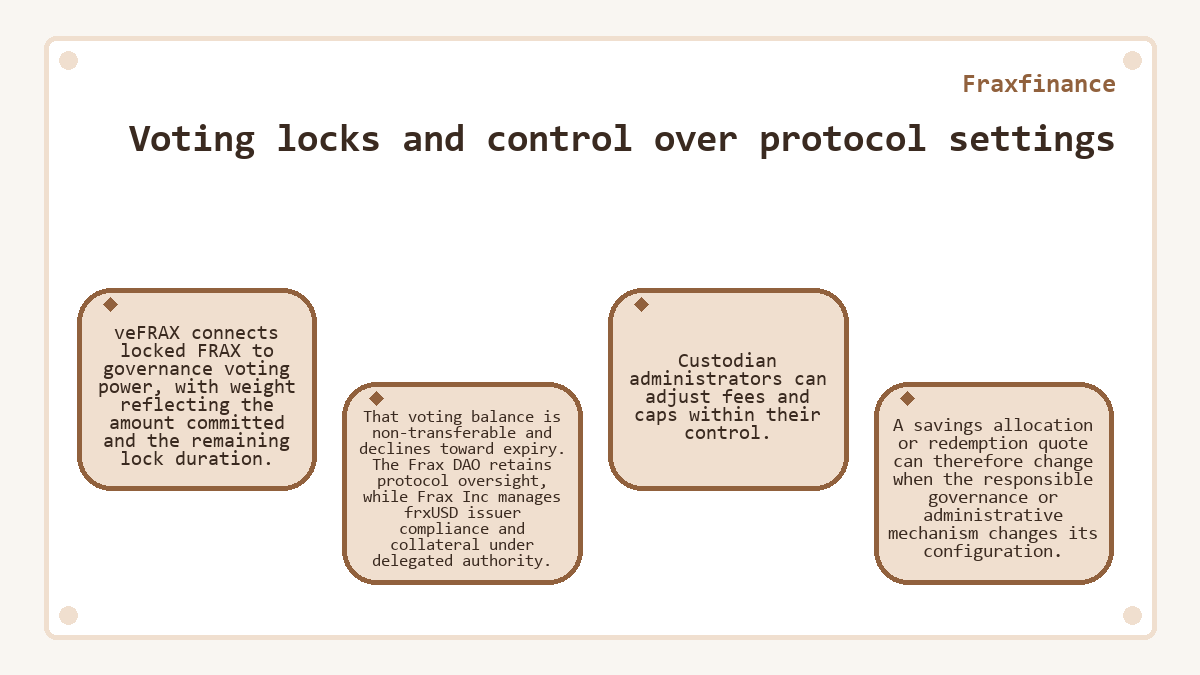
veFRAX connects locked FRAX to governance voting power, with weight reflecting the amount committed and the remaining lock duration. That voting balance is non-transferable and declines toward expiry. The Frax DAO retains protocol oversight, while Frax Inc manages frxUSD issuer compliance and collateral under delegated authority. Custodian administrators can adjust fees and caps within their control. A savings allocation or redemption quote can therefore change when the responsible governance or administrative mechanism changes its configuration.
Everyday questions about Fraxfinance
What costs apply when acquiring or moving frxUSD?
Costs depend on the acquisition method, network execution, and any cross-chain messaging that the route uses. Custodian minting and redemption can carry configurable fees, while pool swaps include trading fees and price impact. Cross-chain transfers can add messaging charges to gas costs. Fiat conversion has its own provider charges, so one fee quotation does not describe every access method.
Can frxUSD reach a U.S. bank account?
FraxNet supports USD withdrawals to linked U.S. checking and savings accounts after the required identity and bank verification. Its bank off-ramp uses frxUSD sent on Ethereum to the assigned liquidation address, with ACH or wire settlement. A balance on another network does not meet that particular route’s funding requirement.
How long can a Frax Ether redemption take?
Frax Ether redemption timing depends on the queue and the ETH available to service claims. In V2, a redemption ticket must reach maturity, and earlier tickets retain priority during an ETH shortage. Reaching the ticket’s timestamp alone does not establish that the entire claim can immediately settle. Validator exit conditions also affect the waiting period.
Is holding frxUSD enough to receive FraxNet rewards?
FraxNet’s reserve-yield participation requires account verification and program eligibility. Frax limits its advertised frxUSD Treasury APR to select strategic partners and institutions, so holding frxUSD alone does not establish eligibility. The account-based rewards route differs from depositing frxUSD into the sfrxUSD savings vault, which creates a tokenized claim on that vault.
Does approving a Frax token transfer custody of the balance?
An ERC-20 approval gives a designated spender an allowance; it does not transfer tokens by itself. The spender can subsequently move tokens within that permission through the token contract. Approval applies to a specific token and spender, and an unused allowance can remain after another transaction finishes. Authorizing one application does not authorize every Frax application.
Which chain handles redemption of a particular FXB series?
An FXB series redeems on the blockchain where its issuing contract originated. That contract holds the LFRAX backing for conversion at maturity. A bridged FXB represents the origin token on another chain and must return to its origin chain for that redemption. Bridging the token does not move its underlying stablecoin backing into a new issuing contract.